How Do We Use Our Own Experiences Without Becoming Trapped by Them?
Doris Lessing’s The Golden Notebook – a 50p charity shop find during a visit to my parents in south-eastern Spain – really is quite the education.
This, from the introduction (which Lessing wrote in 1972, ten years after the novel was first published), felt very prescient, particularly the part about Rome burning:
When I began writing there was pressure on writers to not be ‘subjective’ … ‘Bothering about your stupid personal concerns when Rome is burning’ is how it tends to get itself expressed … Yet all the time novels, stories, art of every sort, became more and more personal … There was no way of not being intensely subjective. The way to deal with the problem of ‘subjectivity’, that shocking business of being preoccupied with the tiny individual who is at the same time caught up in such an explosion of terrible and marvellous possibilities, is to see him as a microcosm and in this way to break through the personal, the subjective making the personal general, as indeed life always does.
As life indeed always does – eventually reducing our triumphs and our tragedies to a shrug of the shoulders, an anecdote to be shared and mulched together with everyone else’s experiences. Lessing’s words made me think about a question I often return to both a writer and an editor: how do we use our own experiences without becoming trapped by them?
Emotional Truth
I always look to Lucia Berlin and her idea of personal, ‘emotional truth’ as one benchmark for my writing and also something I encourage as an editor. Not because every piece of writing must be autobiographical, but because the writer’s particular perspective – their way of noticing, filtering and interpreting the world – is often where the good writing lies.
But Lessing’s quote above also made me think about the writer’s responsibility as a public figure or disseminator of ideas. I remember a writer friend saying to me – after a poem about his time living in Palestine had made a short list for a prestigious prize: “We will make a difference with our writing, Jayne.” And I agreed, as I tend to do when someone says something with conviction, drawing me into a seductive binary with them. But afterwards I thought, I don’t think that’s what I’m going for. Or, more to the point, capable of. I can’t help but narrow the world when I’m writing and filter it through my own experience because that’s the only area where I feel I have any authority. And anyway, neither would I want to miss the opportunity to explode my own particular version of the terrible and the marvellous.
But, of course, plenty of other authors can remove themselves from their work, and some even manage to do both at once – be both subjective and empirical at the same time. Lessing herself is an example. Her work has been described as intensely autobiographical and, at the same time, the Nobel Prize in Literature was given to her in her capacity as an “epicist of the female experience, who with skepticism, fire and visionary power has subjected a divided civilisation to scrutiny.”
The Thinning of Language Against the Density of Our Experience
This, from the novel itself, also caught my eye:
I can’t stop thinking about this phenomenon – that when two of us meet, our discussions are on a totally different level than when there are three people present. Two people, and it is two persons, from a critical tradition, discussing politics as people not communists would discuss them. But more than two, and a different spirit altogether is present. It seems to me this fact is another expression of the fragmentation of everything, the painful disintegration of something that is linked with what I feel to be true about language, the thinning of language against the density of our experience.
Here the discussions referred to are political, but it also reminded me of how writers talk when they get together and discuss writing. Those constantly changing buzzwords and fashions, the name dropping of the newest and hottest properties. Yet in a discussion of just two people, the conversations tend to be humbler, in the sense of relating more to our personal reactions and feelings about the writing versus an appraisal – again returning us to the subjective versus the ‘critical tradition’.
The above is wholly based on my memories and experiences, in particular as related to studying creative writing, then later to writing groups. I never enjoyed those more public, almost performative conversations, but part of not enjoying them, I’m aware, is likely down to not knowing the magic words or names to use. If ever there is a loop to be found, I can be guaranteed to be out of it.
If I had spoken the same language as everyone else, perhaps I would be more likely to join in. Word fashions are seductive in that way: for the moment they are in fashion, they seem to offer that very thing that language always promises but eludes – a perfect, definitive expression. But perhaps in chasing it, we dilute it, thin it, as Lessing says above through her character, Anna.
How to Read a Book
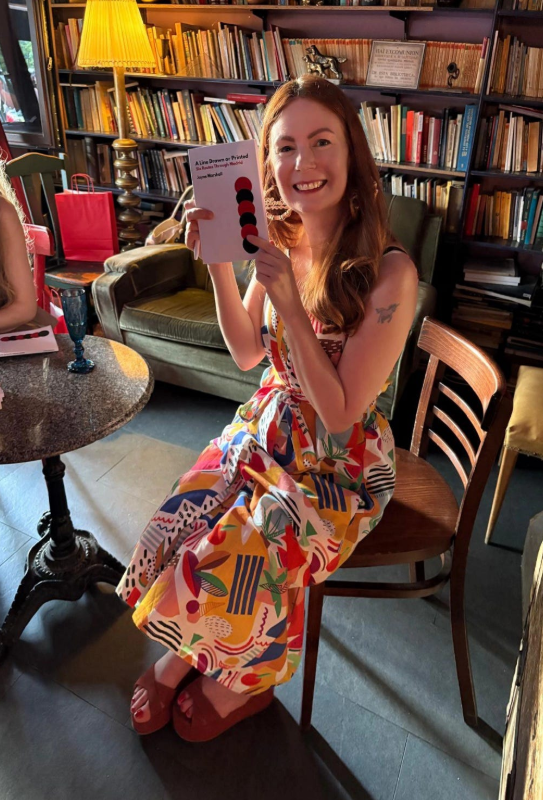
Thinning, diluting, deconstructing, can all be used in their own way to put language and writing to work for a different end. Last week, I was invited to a talk by writer and artist Stephen Emmerson about his project How to Read a Book which finds non-textual readings of books through their lines and stains and creases as a way to explore language, writing, and memory, alongside themes of neurodiversity, including dyslexia. Some of these he then uses to form poetry templates, or Wormholes:
The Wormholes templates were made by tracing bookworm holes found in old books. Place one of the Wormholes over a page of text and read the words and word-fragments that remain. Use them to create experimental poems, sound poems, audio performances and vocal improvisations.
At the event he read some of his own poetry using a Wormhole template and it was brilliantly surreal. The words sounded like… something, yet not words, but there was something there, something that made you feel and understand something. (See how language fails us?!)
Other non-textual readings utilise the foxing – the brown stains on an old book – to make what looks like a map of the universe and its stars. How about that for the specific exploding our perspective towards the enormous in truly marvellous fashion? From brown stain to a contemplation of the universe. Just one of the uses we can put art to while Rome continues to burn. It is also one of the (many) reasons I love working with writers: every manuscript contains its own particular universe, waiting to be discovered, shaped and shared.

